
Published: February 2026 | Reading Time: ~14 minutes
Quick disclosure: This post contains affiliate links. If you purchase through them, we may earn a small commission at no extra cost to you. We only recommend products we’ve genuinely researched and stand behind.
If you’ve been doing any research into salmon DNA skincare, you’ve probably run into two very different worlds when it comes to topical vs injectable PDRN. On one side, there are the serums and creams lining the K-beauty shelves. These serums are accessible, affordable, and safe to use at home every morning. On the other side, there’s a whole clinical universe of injectable PDRN treatments. These include Rejuran Healer, skin boosters, mesotherapy and are a staple of Korean dermatology clinics and are quietly making their way into aesthetic practices in the US, UK, and Australia.
Same ingredient. Completely different experience. Very different results.
The question most people end up asking regarding topical vs injectable PDRN and most skincare articles dodge with a vague “talk to your doctor” is: do I actually need the injectable version, or can a good serum get me where I want to go?
That’s exactly what we’re going to answer here between topical vs injectable PDRN. No filler, no fear-mongering, no unnecessary complexity. Just a straight-up breakdown of how each format works, what each one can and can’t do, who genuinely needs which one, and what to realistically expect from both.
The 7 Key Differences Between Topical and Injectable PDRN:
- Where the PDRN actually ends up in your skin — surface layers vs. directly in the dermis
- The penetration challenge — why molecular size matters and how smart brands are solving it
- What results each format can realistically deliver — and where each one hits its limits
- The real-world experience — a pleasant daily serum routine vs. a clinical procedure with downtime
- The cost difference — $15–$60 per bottle vs. $300–$700+ per session
- Who each format is actually right for — and the specific skin concerns that tip the scales
- How they work better together than apart — the hybrid approach that gets the most from both
Let’s start with what both formats have in common, because this part is important.
Both topical and injectable PDRN are derived from the same source, which is purified polydeoxyribonucleotide fragments extracted from salmon DNA. Both work through the same fundamental biological pathways: activating adenosine A2A receptors on skin cells, stimulating collagen and elastin production, reducing inflammation, and supporting cellular repair. The mechanism is identical. The ingredient, at its core, is the same.
What’s completely different is where the PDRN ends up in your skin and that difference changes everything about what it can do.
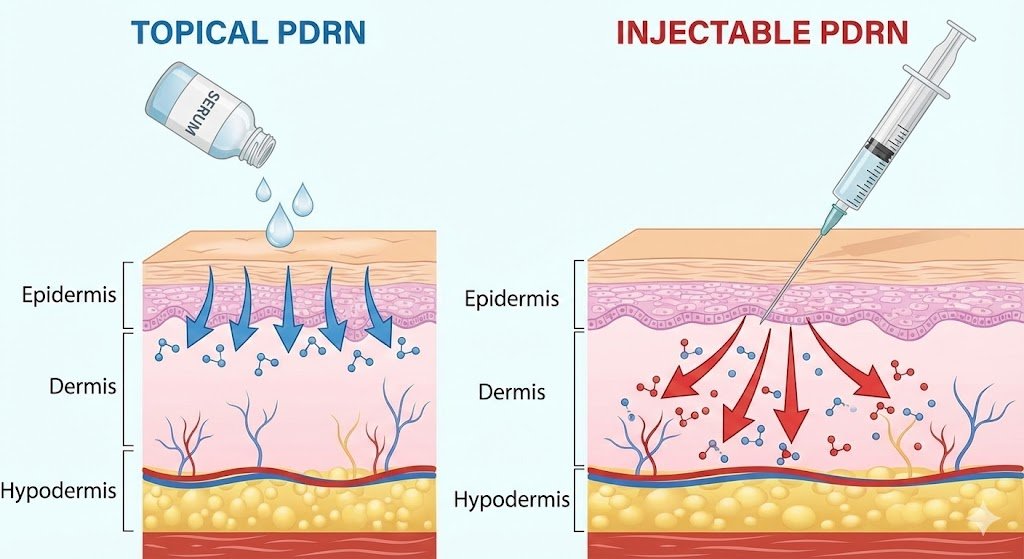
Think of it like watering a plant. Topical PDRN is like watering from the top some water reaches the roots, but most of it works on the surface and the upper layers. Injectable PDRN is like a targeted drip system that delivers water directly to the roots. Same water, completely different reach.
Injectable PDRN, most famously sold under the brand name Rejuran Healer is administered by a trained aesthetic practitioner using microinjections directly into the dermis. This is the deep layer of your skin where your fibroblasts live and the cells responsible for producing collagen, elastin, and hyaluronic acid.
By delivering PDRN straight into the dermis, the injectable format bypasses the skin barrier entirely. There’s no penetration challenge, no molecular size limitation, no question of whether the active ingredient is reaching the cells that can use it. It goes directly where it needs to go.
A typical Rejuran or injectable PDRN session looks something like this:
Not all injectables are the same. The main variants you’ll encounter are:
Rejuran Healer — the original and most well-known, designed for overall skin regeneration, hydration, and anti-aging. Medium viscosity and suitable for full-face treatments.
Rejuran I — a lower-viscosity formulation specifically designed for the delicate under-eye area, where it targets dark circles, fine lines, and thinning skin.
Rejuran S — a higher-viscosity formulation designed specifically for acne scarring, acting similarly to a micro-filler for depressed or sunken scars.
PN Skin Boosters — polynucleotide skin boosters are a related category that uses longer polynucleotide chains. Popular in Europe and gaining traction globally.
Topical PDRN including serums, essences, ampoules, and creams deliver PDRN to the surface of the skin and the upper layers of the epidermis. From there, some of it penetrates further depending on the formulation technology, the molecular weight of the PDRN, and the condition of your skin barrier.
In the upper skin layers, topical PDRN is genuinely active and useful. It hydrates, soothes, supports barrier function, reduces surface inflammation, and begins stimulating cellular activity at the level it can reach. The question isn’t whether topical PDRN works, but rather how deep that work happens.
For the majority of people with everyday skincare goals topical PDRN is completely sufficient. This includes hydration, a healthy glow, gentle anti-aging support, barrier repair, post-acne healing . The clinical evidence for topical benefits including hydration improvement, barrier reinforcement, and anti-inflammatory effects is strong and consistent.
Where topical starts to show its limits is in addressing deeper structural concerns: significant collagen loss, pronounced wrinkles, acne scarring, and loss of elasticity at the dermal level. These benefits require PDRN to reach the dermis and topical formulations, even very good ones, have a harder time reliably achieving that without penetration-enhancing technology.
Here’s the honest science behind why topical PDRN is more complicated than topical hyaluronic acid or niacinamide.
PDRN molecules are relatively large. Your skin’s outer layer, called the stratum corneum, is specifically designed to keep large molecules out. It’s your body’s first line of defense, and it’s very good at its job. This means that a significant portion of high-molecular-weight PDRN applied topically stays in the superficial layers rather than penetrating to the dermis where fibroblasts live.
The good news is that the skincare industry is not standing still on this. Several smart formulation approaches are actively improving topical PDRN’s penetration:
Low-molecular-weight / hydrolyzed PDRN — breaking PDRN into smaller fragments that can slip through the skin barrier more easily. Most high-quality topical PDRN products now use hydrolyzed or low-MW PDRN for this reason.
Liposomal encapsulation — wrapping PDRN in lipid-based carriers (liposomes) that mimic the skin’s own lipid structure, allowing them to merge with the skin barrier and release their cargo deeper. Anua’s Smart Capsule Technology works on this principle and has the clinical data to back it up.
Nanotechnology — nano-sized particles that carry PDRN past the barrier’s defenses through size alone.
Penetration enhancers — ingredients like niacinamide and certain humectants that temporarily create more permeable conditions in the stratum corneum.
Advanced topical PDRN formulations using technologies like liposomal encapsulation or nanotechnology can improve PDRN bioavailability by up to 60% compared to simple aqueous solutions. That’s a meaningful improvement although it’s worth being clear that even with this boost, topical PDRN still doesn’t match the dermis-level delivery of an injection.
The practical takeaway for topical vs injectable PDRN: the formulation technology matters enormously for topical PDRN. A premium serum with smart delivery technology is meaningfully more effective than a cheap serum with PDRN listed near the bottom of its ingredient list.
Let’s be very direct here, because this is the section that matters most when it comes to topical vs injectable PDRN.
Injectable PDRN has the most robust clinical evidence of any PDRN format. A 2023 study involving 120 participants showed that 87% saw visible improvements in skin hydration and firmness after 3 sessions, spaced 4 weeks apart.
In clinical practice, injectable PDRN is well-documented for:
Topical PDRN is genuinely effective for a different but equally real set of benefits:
The key difference is depth, speed, and magnitude. Injectable PDRN works faster, goes deeper, and produces more dramatic structural changes. Topical PDRN works more gradually, operates primarily at the surface and upper dermal layers, and delivers benefits that are real but more incremental.
Beyond the science, here’s what each actually feels like as an experience regarding topical vs injectable PDRN.
Using a PDRN serum every morning and evening is genuinely pleasant. There’s no downtime, no preparation, no appointment. You cleanse, apply your PDRN serum to slightly damp skin, follow with moisturizer and SPF, and get on with your day. No redness, no recovery, no disruption to your life whatsoever.
Results build quietly and consistently. Most people notice hydration improvements within the first week or two. Skin starts to feel more resilient, more supple, and calmer. The glow that PDRN is famous for, including that well-rested, deeply nourished look, typically shows up within 3–4 weeks. Structural improvements like firmness and texture refinement accumulate over 8–12 weeks of daily use.
It’s the skincare equivalent of eating well and sleeping enough. The changes are real, but they’re gradual and they work with your life rather than requiring anything from it.
Getting injectable PDRN is a clinical procedure. You’re booking a consultation, visiting a practitioner, having your face numbed, and receiving dozens of microinjections. For most people, discomfort is minimal. In fact most describe it as a mild prickling sensation, but it’s not nothing. It’s important to take in account your country’s regulatory approval laws to see if injectable PDRN is allowed in your country.
The first 24–48 hours post-treatment typically involve mild redness and small raised bumps at injection sites. These resolve quickly, but you probably don’t want to schedule a job interview the same afternoon. After a few days, the skin settles and you start to feel the benefits: a plumper, more hydrated quality to the skin, early improvements in texture, and a general sense of the skin looking more “alive.”
The full results of a PDRN injectable treatment develop over weeks to months as collagen production increases. Most protocols recommend a series of 3–4 sessions spaced 4–6 weeks apart for optimal results, followed by maintenance sessions every 6–12 months.
It asks more of you than a serum does but when you’re targeting something that requires dermal-level treatment, it delivers in kind.
The price difference between topical and injectable PDRN is significant enough to deserve its own section when comparing topical vs injectable PDRN.
A high-quality PDRN serum typically runs between $15 and $60 for a full-size bottle lasting 4–6 weeks. That’s roughly $100–$400 per year for daily use, depending on the product you choose. The products we recommend in our 9 Best Salmon DNA Serums guide range from $15 (Medicube) to $55 (Rejuran topical ampoule).
Typical Rejuran price ranges per session: Rejuran Healer $300–$700, Rejuran S for scars $350–$800, and Rejuran I for under-eye treatment $250–$600.
A full initial treatment course of 3–4 sessions means an upfront investment of roughly $900–$2,800 depending on your location, the variant used, and your practitioner. Add maintenance sessions every 6–12 months and you’re looking at an ongoing annual cost of $300–$700+ to sustain results.
In South Korea, where the treatment was developed and competition is highest, prices are 20–30% lower than Western markets. Medical tourism to Seoul specifically for PDRN treatments is genuinely common among serious skincare enthusiasts.
The honest way to think about this isn’t “which is cheaper” but “which is appropriate for what I’m trying to achieve.” If your goal is daily skin maintenance, hydration, glow, and gentle anti-aging support, topical PDRN is excellent value and the right tool for the job. If you’re trying to address significant collagen loss, deep wrinkles, acne scarring, or you want the most clinically validated anti-aging results available without surgery, the injectable price tag starts to make sense.
Topical PDRN is right for you if any of these describe your situation:
You’re building a preventative routine in your 20s–30s. The best time to start supporting collagen production and barrier health is before significant damage accumulates. PDRN serums fit seamlessly into a daily routine at this stage.
Your primary concerns are hydration, glow, and gentle anti-aging. These are topical PDRN’s strongest suits and it delivers them consistently and well.
You have sensitive, reactive, or post-procedure skin. PDRN’s anti-inflammatory mechanism makes it ideal for anyone whose skin needs calming support.
You’re in post-acne healing mode. Surface-level PDRN works directly on the tissue repair and inflammation reduction that post-acne skin needs.
You want to support and extend the results of injectable treatments. Using topical PDRN between clinic sessions is one of the smartest ways to get more from your injectable investment.
Needles are a hard no. Completely valid. Topical PDRN gives you meaningful access to the same ingredient and similar biological pathways without anything clinical.
You’re working within a budget. At $15–$60 per bottle, you can use a genuinely excellent PDRN serum for the annual cost of a single injectable session.
(It’s important to take in account your country’s regulatory approval laws to see if injectable PDRN is allowed in your country.) Injectable PDRN deserves serious consideration if:
You’re dealing with acne scarring, particularly depressed or pitted scars. This is one of the clearest cases where injectables outperform anything topical. Rejuran S specifically targets depressed scarring with results that no serum can replicate.
You have significant collagen loss or pronounced wrinkles. If you’re looking to meaningfully reverse structural aging rather than just maintain, the dermal-level collagen stimulation of an injectable is a different category of result.
Under-eye concerns are your priority. Dark circles with a hollowed or crepey quality, significant fine lines around the eyes — these respond exceptionally well to Rejuran I in a way that topical products simply can’t match.
You want faster, more dramatic results. Injectables deliver noticeable improvement in skin quality within weeks. If you’re preparing for a wedding, a significant event, or simply have a specific timeline, injectables get you there faster.
You’re already investing in aesthetic treatments. If you’re already getting laser treatments, microneedling, or other clinical procedures, adding PDRN injections to your protocol is a natural complement that enhances recovery and results.
You’re in your 40s+ with moderate to significant skin aging. The structural changes that accumulate with age are increasingly addressed more efficiently by dermal-level treatment than surface products alone.
Here’s the approach that the most informed practitioners and skincare enthusiasts are taking and it makes excellent biological sense when comparing topical vs injectable PDRN.
Injectable PDRN does the heavy lifting: it delivers PDRN deep into the dermis, triggers significant collagen production, and creates structural improvements that topical products can’t fully replicate. Topical PDRN then maintains and extends those results between sessions: daily A2A receptor activation, consistent hydration support, ongoing anti-inflammatory protection, and surface-level repair.
Think of injectables as the renovation and topicals as the ongoing maintenance. Each makes the other more valuable.
A hybrid approach combining regular injectable PDRN with daily PDRN skincare offers the best of both worlds: immediate rejuvenation and long-term skin health.
Practically speaking, the hybrid approach might look like this: 3–4 injectable sessions spaced 4–6 weeks apart for your initial treatment course, then one maintenance session every 6–12 months. Daily topical PDRN serum morning and evening throughout. The topical product keeps your skin in its best possible baseline state, which maximizes what the injections can achieve and extends how long the results last. It’s important to take in account your country’s regulatory approval laws to see if injectable PDRN is allowed in your country.
If you’re ready to start with topical PDRN as a standalone routine or to complement future injectable treatments, these are our current top recommendations.
The most consistently recommended entry point into PDRN skincare. At 10,000 ppm concentration with five peptides, niacinamide, and adenosine reinforcing the A2A receptor pathway, it’s a genuinely well-formulated product at an accessible price. Over 6,600 five-star Amazon reviews speak for themselves.
Best for: First-time PDRN users, everyday use, brightening and hydration.
Find the Medicube PDRN Pink Peptide Serum on Amazon
Anua’s Smart Capsule Technology is one of the most credible delivery systems in the topical PDRN market. It is clinically shown to increase hyaluronic acid synthesis in dermal fibroblasts by 81.8% and collagen content by 67.6%. If deep, multi-layer hydration is your priority, this is hard to beat.
Best for: Dehydrated and dry skin, glass skin goals, anyone who wants clinical efficacy data behind their product.
Find the Anua PDRN Hyaluronic Acid Capsule 100 Serum on Amazon
If you want the closest thing to the injectable Rejuran experience in a topical format, this is it. Formulated with the same patented c-PDRN® technology used in Rejuran’s clinical injectables and delivered via their proprietary DOT® absorption technology, it’s the topical product most directly bridging the gap between clinic and home care.
Best for: Mature or aging skin, anyone already familiar with Rejuran injectable treatments, serious anti-aging focused users.
Find the Rejuran Turnover Ampoule on Amazon
For anyone avoiding salmon-derived ingredients, VT Cosmetics delivers 100,000 ppm of ginseng-derived vegan PDRN alongside five ceramides and a comprehensive barrier repair complex. The highest-concentration vegan PDRN product currently on the market.
Best for: Vegan skincare, fish allergy concerns, barrier-compromised skin.
Find the VT Cosmetics PDRN 100 Essence on Amazon
Can topical PDRN replace injectable PDRN entirely?
For most people with everyday skin maintenance goals, yes. Topical PDRN is completely sufficient. For deeper structural concerns like significant collagen loss, pronounced wrinkles, or acne scarring, topical products can’t fully replicate what dermis-level injection achieves. It’s less a case of one replacing the other and more a question of which is right for your specific goals.
Is injectable PDRN safe?
Injectable PDRN has an excellent safety profile with decades of clinical use. When administered by a trained practitioner in a sterile environment, serious adverse reactions are rare. The most common side effects are mild redness, swelling, and bruising at injection sites, which typically resolve within 1–2 days. As with any injectable procedure, choosing a qualified practitioner matters enormously.
Is injectable PDRN available in the US?
Injectable PDRN is not FDA-approved for cosmetic use in the United States, but it is available at some aesthetic clinics as an off-label service. Availability is growing as the treatment gains recognition. Topical PDRN products are fully legal and widely available.
How long do injectable PDRN results last?
Results vary by individual, but most patients see effects lasting 6–12 months from a full initial treatment course. Maintenance sessions every 6–12 months are typically recommended to sustain results.
Can I use topical PDRN right after an injectable treatment?
Yes and it’s actually recommended. Applying a gentle PDRN serum post-injection (once the initial redness has settled) can support healing, reduce inflammation, and help maintain the results of your treatment. Many practitioners specifically recommend it as part of post-procedure home care.
How long do topical PDRN results last?
Topical PDRN results are maintained through consistent use. This is a daily skincare ingredient, not a one-time treatment. The benefits continue and compound as long as you keep using it. If you stop, the skin gradually returns to its pre-use baseline over time.
Is PDRN safe during pregnancy?
Topical PDRN is generally considered low risk, but injectable PDRN is not recommended during pregnancy or breastfeeding due to insufficient safety data. Always consult your healthcare provider before any new skincare or aesthetic treatment during pregnancy.
Here’s the straightforward version of everything above:
Topical PDRN works at the surface and upper skin layers. It’s accessible, affordable, gentle, and genuinely effective for hydration, barrier support, anti-inflammatory care, and gradual anti-aging maintenance. For the vast majority of people, it’s the right starting point. For many, it’s all they’ll ever need.
Injectable PDRN works in the dermis. It’s more dramatic, faster, and directly addresses structural concerns that topical products can’t fully reach. It requires a clinical setting, a trained practitioner, a real budget, and some tolerance for a minor procedure. For people with significant collagen loss, acne scarring, pronounced aging, or specific under-eye concerns, it’s a genuinely transformative option.
The hybrid approach — daily topical PDRN plus periodic injectable sessions is the most comprehensive way to use this ingredient, with both formats reinforcing each other’s benefits.
Start with a great topical serum. Build the habit, understand how your skin responds, and see how far it takes you. If and when you want to go deeper, the injectable option will be there, and the topical foundation you’ve built will make it even more effective.
Want to find the best topical PDRN serum for your skin type and budget? We’ve done the legwork in our 9 Best Salmon DNA Serums guide — with honest reviews across every price point. Or if you’re still building your understanding of the ingredient, our complete science guide covers everything from the extraction process to the clinical research.