
Published: February 2026 | Reading Time: ~15 minutes
Quick disclosure: This post contains affiliate links. If you purchase through them, we may earn a small commission at no extra cost to you. We only recommend products we’ve genuinely researched and stand behind.
PDRN vs Retinol: You’ve probably heard both names more times than you can count. Retinol has been the skincare world’s gold standard for decades. It is the ingredient every dermatologist reaches for when someone walks in asking about anti-aging. But lately, a new challenger has been making serious noise: PDRN, the salmon DNA ingredient that sounds like it belongs in a science fiction novel but is rapidly earning its place in serious skincare routines worldwide.
So between PDRN vs retinol, which one is actually worth your money? And do you even have to choose?
The honest answer is more nuanced than most comparison articles will tell you, and that’s exactly what we’re going to get into here. By the end of this, you’ll know how each ingredient works, what they’re genuinely good at, where they fall short, who should be using which, and how to combine them if you want the best of both worlds. We’ll also point you to specific products we trust for each approach.
Let’s start from the beginning.
Retinol is a form of Vitamin A and it belongs to a broader family of ingredients called retinoids. Examples of retinoids includes prescription-strength tretinoin and more gentle over-the-counter options like retinaldehyde. It’s been studied in clinical settings since the 1970s and has one of the most extensive evidence bases of any skincare ingredient in existence, with published Pubmed articles detailing current research.
Once retinol is applied to skin, it gets converted by enzymes into retinoic acid, which is the biologically active form that actually does the work. Retinoic acid binds to nuclear receptors inside skin cells, switching on a cascade of genetic activity. The skin accelerates its cell turnover rate, sheds dead cells faster, and ramps up collagen production in the dermis.
Think of retinol as a drill sergeant for your skin cells. It gets results, but it gets them by pushing hard.
The benefits of retinol backed by decades of clinical evidence include:
Wrinkle reduction — multiple large-scale studies demonstrate measurable improvements in fine lines and deeper wrinkles with consistent retinol use over 12–24 weeks.
Skin texture and tone — retinol’s accelerated cell turnover smooths uneven texture, fades hyperpigmentation, and gives skin a more refined appearance over time.
Acne treatment — retinoids are among the most effective treatments for acne, both because they speed up cell turnover (reducing the buildup that causes clogged pores) and because they have anti-inflammatory properties.
Photoaging reversal — retinol has specific, well-documented benefits for reversing UV-induced skin damage, including sunspots, collagen degradation, and loss of skin elasticity caused by years of sun exposure.
The trade-off? The same mechanism that makes retinol so effective is what makes it difficult for many people to use. More on that shortly.
PDRN stands for Polydeoxyribonucleotide. They are essentially fragments of DNA extracted and purified from salmon sperm. If that sounds alarming, don’t worry: the final product is so heavily processed and purified that it contains zero fish proteins, zero fish allergens, and bears no resemblance to raw salmon biology. What you’re left with is short chains of nucleotides, the building blocks that make up DNA. These nucleotides interact with your skin cells in a very specific and well-understood way.
PDRN has been used in medical settings for over 40 years, originally developed in Italy for wound healing and radiation-damaged tissue. It’s been a mainstream aesthetic treatment in South Korea for over a decade in its injectable form. The consumer-facing topical serum market is newer but growing extremely quickly, driven largely by K-beauty’s global influence.
PDRN works through two main biological pathways:
Adenosine A2A receptor activation — Research in Frontiers in pharmacology detail when PDRN is metabolized, it releases adenosine, which binds to A2A receptors on your skin’s fibroblast cells (the cells responsible for producing collagen and elastin). This triggers collagen and elastin synthesis, suppresses inflammatory signaling, and promotes hyaluronic acid production in the extracellular matrix.
The nucleotide salvage pathway — the nucleotide fragments in PDRN are taken up by skin cells as raw material for repair. Rather than synthesizing these building blocks from scratch, cells use PDRN’s pre-assembled nucleotides to accelerate repair and regeneration. This is particularly relevant for stressed, damaged, or post-procedure skin.
If retinol is a drill sergeant, PDRN is more like a highly capable support team. It works with your skin’s existing biology to help it do its job better, faster, and with less collateral damage.
For a much deeper dive into how PDRN works at the cellular level, head over to our complete science guide.
This is the most important concept to understand when comparing PDRN vs retinol and where most comparison articles settle for a vague “both boost collagen” summary. When considering PDRN vs retinol, you must consider the following:
Retinol works by controlled disruption. It speeds up skin cell turnover by creating a mild, managed stress response in your skin cells. That stress response triggers collagen production and faster renewal but it also triggers the inflammation, peeling, and sensitivity that many retinol users experience, especially at the beginning. The skin gets better by going through something.
PDRN works by biological support. It doesn’t create a stress response. Instead, it communicates with skin cells through specific receptors and encourages them to do more of what they naturally do. This includes producing collagen, fighting inflammation, and repairing damage. There’s no disruption phase. The skin gets better because it’s being given the right signals and the right raw materials.
This distinction has a very practical consequence for how each ingredient feels to use, how quickly you see results, and crucially, who can tolerate them when choosing between PDRN vs retinol.
| Comparison Point | PDRN (Salmon DNA) | Retinol (Vitamin A) |
|---|---|---|
| Origin / Source | Marine-derived. Extracted and highly purified from salmon sperm DNA, which is up to 95% structurally similar to human DNA. | Synthetic or animal-derived. A potent derivative of Vitamin A formulated in lab settings for topical application. |
| Primary Mechanism of Action | Cellular Repair. Binds to adenosine A2A receptors to stimulate fibroblasts, promote angiogenesis (new blood vessels), and suppress inflammatory cytokines. | Cellular Turnover. Binds to retinoic acid receptors to accelerate the shedding of dead skin cells and force the generation of fresh cells and collagen. |
| Main Clinical Benefits | Accelerated wound healing, scar tissue repair, dramatic reduction in inflammation, enhanced skin thickness, and deep dermal hydration. | Reduction of fine lines and deep wrinkles, fading of hyperpigmentation and sun spots, acne control, and overall smoothing of skin texture. |
| Irritation & Barrier Risk | Extremely Low. PDRN actively repairs and strengthens a compromised skin barrier. It is inherently soothing. | High. Frequently causes “retinization” (redness, flaking, dryness) and temporarily compromises the skin barrier as it forces cellular turnover. |
| Sun Sensitivity | None. Safe for daytime use and often utilized by dermatologists to speed up recovery after sun damage or clinical laser treatments. | High. Retinol degrades under UV light and makes newly exposed skin highly vulnerable to sunburn. Strict nighttime use and daily SPF are required. |
| Best Suited For | Sensitive, thinned, mature, or damaged skin. Excellent for rosacea-prone skin or post-procedure recovery (microneedling, chemical peels). | Resilient, oily, acne-prone, or aging skin that has established wrinkles and can tolerate active chemical exfoliation. |
| Speed of Results | Immediate soothing and hydration. Structural tissue repair and enhanced elasticity become visible within 2 to 4 weeks of consistent application. | Long-term commitment. Visible anti-aging and textural improvements typically take 8 to 12 weeks, often preceded by a “purging” phase. |
Here’s an honest breakdown of PDRN vs retinol by specific skin concern rather than the usual wishy-washy “both are good for aging” summary:
Retinol wins here, particularly for deep-set wrinkles and significant photoaging. Its collagen-stimulating effects are backed by more large-scale, long-term clinical trials than any other topical active. If reversing visible aging is your primary goal and your skin can tolerate it, retinol delivers the most validated results.
PDRN has meaningful anti-aging benefits, particularly in injectable form. Topical PDRN’s collagen-stimulating effects are real but more mild. The question of skin penetration limits how much A2A receptor activation happens at the dermal level from topical application alone. Consistent long-term use does produce measurable improvements in elasticity and fine lines, particularly when formulated with good penetration-enhancing technologies.
PDRN vs retinol Winner: Retinol (for established wrinkles and significant photoaging)
PDRN wins convincingly here. It stimulates the skin’s own hyaluronic acid production through the A2A pathway, supports fibroblast activity in the extracellular matrix, and its anti-inflammatory effects directly reduce the chronic inflammation that degrades barrier function. Most users notice improved hydration within two to four weeks.
Retinol actively compromises the skin barrier in many users, particularly in the early months of use. The accelerated cell turnover strips the natural lipid barrier, leading to transepidermal water loss. This is why retinol and moisturizer are so frequently paired. You need to actively counteract retinol’s drying effect.
PDRN vs retinol Winner: PDRN (and it’s not close)
PDRN is gentle enough for the most reactive skin types. Its anti-inflammatory mechanism makes it actively calming for sensitive, rosacea-prone, or reactive skin. There’s also no irritation threshold. You don’t need to build up slowly or go through a retinization period.
Retinol is well known for an adjustment period during which many users experience redness, peeling, flaking, and stinging, particularly at higher concentrations. Some people never fully tolerate it. The “sandwich method” (applying moisturizer before and after retinol) exists precisely because the ingredient is so reliably irritating for beginners.
PDRN vs retinol Winner: PDRN (dramatically so for sensitive skin)
PDRN was literally developed in medical settings for wound healing. Wound healing is its clinical origin story. It accelerates healing, reduces post-inflammatory hyperpigmentation, and supports tissue repair. For anyone dealing with active breakouts, post-acne marks, or skin recovering from any kind of trauma, PDRN is the clear choice.
Retinol helps with acne through cell turnover and pore-clearing, but can initially cause purging that makes breakouts look worse before they improve. It’s not suitable for actively irritated or compromised skin.
PDRN vs retinol Winner: PDRN (for healing and post-acne recovery)
Retinol wins here. Its ability to regulate cell turnover, clear congested pores, and reduce sebum buildup makes it one of the most effective topical tools for acne-prone skin when used consistently. Retinoids are a cornerstone of dermatological acne treatment for good reason.
PDRN can support healing and reduce inflammation associated with acne, but it doesn’t address the underlying mechanisms of pore congestion and excess sebum the way retinol does.
PDRN vs retinol Winner: Retinol (for acne prevention and significant texture concerns)
Retinol has solid evidence for fading hyperpigmentation through accelerated cell turnover. Retinol pushes out the pigmented cells, to help bring in with fresh ones.
PDRN has an emerging and genuinely interesting mechanism for brightening through inhibition of MITF (the transcription factor that regulates melanin production), but the topical evidence base for hyperpigmentation specifically is still developing. Many users report brightening effects, and it’s a promising area of ongoing research.
PDRN vs retinol Winner: Retinol (more established evidence, though PDRN is catching up)
If you’re starting retinol for the first time, here’s a realistic timeline that most skincare guides gloss over:
Weeks 1–4: The adjustment phase, sometimes called “retinization.” Expect some combination of dryness, flaking, redness, and increased sensitivity. Some people experience purging, which is a temporary increase in breakouts as retinol accelerates cell turnover. This is normal and temporary, but it’s genuinely uncomfortable for many people.
Weeks 4–12: The irritation typically subsides as your skin adapts. You’ll start noticing improved texture and a more refined appearance. Early improvements in fine lines can begin to show.
Months 3–6: This is where the meaningful anti-aging benefits become visible. There are measurable improvements in skin elasticity, wrinkle depth, and overall skin tone.
Ongoing: Retinol requires consistent, long-term use to maintain and build its benefits.
Practical tips for starting retinol: Always start at the lowest available concentration (0.025% or 0.03%) and increase gradually. Use it only at night. Retinol degrades in sunlight and increases photosensitivity. Wear SPF every single morning without exception. This is non-negotiable with retinol use. Try the “sandwich method” if you experience significant irritation: moisturizer → retinol → moisturizer. Introduce slowly, only two to three nights per week and not every night.
PDRN has a very different user experience, notably more simple and gentle.
Week 1–2: Most users notice improved hydration quickly. Skin feels more supple and comfortable. If you have sensitive or reactive skin, you’ll likely notice reduced redness and reactivity within the first two weeks.
Weeks 2–6: Continued hydration improvement. Post-acne marks may begin to fade. Skin texture starts to improve. Skin recovers faster from minor irritation or environmental stress.
Weeks 6–12: The more structural benefits accumulate. This includes improved elasticity, firmer-feeling skin, and continued texture refinement. The collagen-stimulating effects build gradually over time.
Practical tips for using topical PDRN: – Can be used morning and evening, there are no photosensitivity concerns. It pairs well with almost everything in your routine. Consistent daily use produces better results than occasional use and the benefits compound. Be sure to look for formulations that disclose PDRN concentration (0.5%–1.0% is the clinically relevant range) Finally, Combining with microneedling sessions significantly enhances absorption in professional settings
Retinol is the right choice for you if:
Your skin is resilient and non-sensitive. If you can tolerate exfoliants, strong vitamin C serums, and other actives without significant irritation, you’re likely to do well with retinol.
Your primary concern is established photoaging. This includes deeper wrinkles, significant sun damage, uneven skin tone from years of UV exposure. Retinol’s evidence base for reversing photoaging is unmatched in the topical skincare world.
You’re dealing with persistent acne or significantly congested skin. Retinol’s pore-clearing and cell-turnover benefits are particularly valuable here.
You’re in your late 20s or 30s as a preventative measure. Starting a low-concentration retinol routine is one of the most evidence-backed things you can do for your long-term skin health.
You’re patient and committed. Retinol rewards consistency. If you’re willing to get through the adjustment phase and stick with it, the long-term payoff is real.
PDRN is the right choice, or the right addition, for you if:
You have sensitive, reactive, or rosacea-prone skin. If you’ve tried retinol and your skin simply can’t tolerate it, PDRN gives you a meaningful regenerative option without the irritation tradeoff.
You’re in post-procedure recovery. After laser treatments, microneedling, chemical peels, or any aesthetic procedure, PDRN is exceptionally well-suited to accelerate healing and reduce inflammation.
You’re dealing with post-acne healing. If you’re working through acne scarring, hyperpigmentation, or skin compromised from breakouts, PDRN’s wound-healing origins make it ideally suited for this work.
You have mature or significantly dehydrated skin. The hydration benefits are immediate and meaningful, and the barrier-supporting effects are particularly valuable for skin that has lost moisture-retaining capacity with age.
You want to run retinol more effectively. This is one of the most compelling use cases for PDRN. Using PDRN alongside retinol to mitigate irritation and barrier disruption while letting retinol do its anti-aging work.
You’re new to active skincare. PDRN is one of the most accessible step-up ingredients from a basic moisturizer. It delivers genuine biological benefits without requiring a tolerance-building period.
Yes, and for many skin types, this is actually the optimal approach.
Retinol drives results through controlled disruption. Its biggest limitation is the irritation, barrier compromise, and sensitivity that come with that disruption. PDRN specializes in exactly the things retinol lacks: barrier repair, anti-inflammatory support, and cellular regeneration without stress. They fill each other’s gaps almost perfectly.
This isn’t just theoretical. The combination has been explored in clinical settings, and the practical wisdom in professional aesthetics has been pointing in this direction for years. Several K-beauty brands have already released formulations combining both ingredients in a single product precisely because the synergy is so logical, and we’ll point you to one of them below.
The key caveat: don’t introduce them at the same time if you’re new to either ingredient. Establish your retinol tolerance first, then layer in PDRN. The alternative is you can start with PDRN and add retinol later. Trying to adjust to both simultaneously makes it impossible to know what’s causing any reaction.
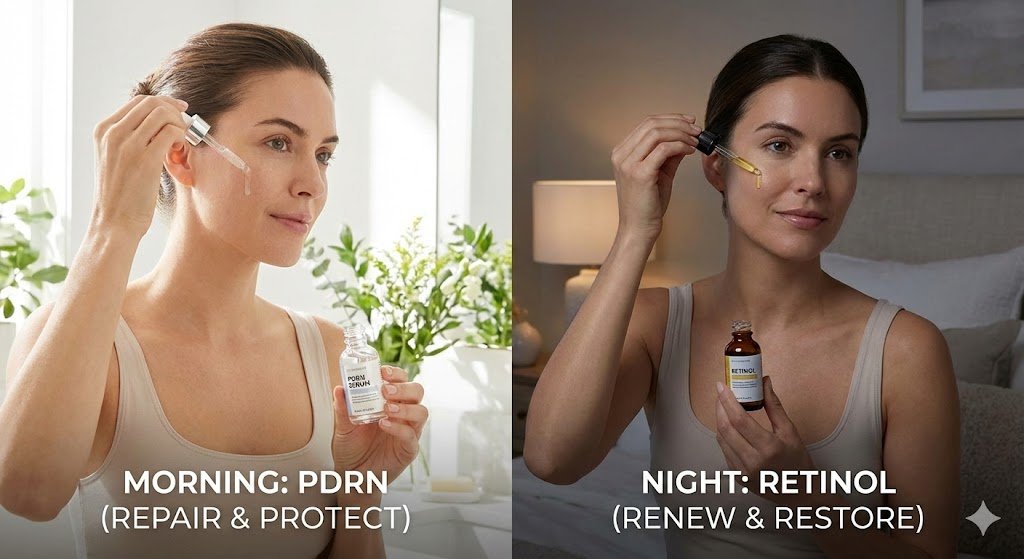
Here are three practical routines depending on your experience level and skin type:
Morning: Cleanser → PDRN serum → moisturizer → SPF
Evening: Cleanser → PDRN serum → retinol → moisturizer
Apply PDRN first on slightly damp skin, wait 5 minutes, then apply retinol. The PDRN creates a slightly buffered, hydrated environment for the retinol which can improve tolerability. Follow with moisturizer to lock everything in.
Every Morning: Cleanser → PDRN serum → moisturizer → SPF
Alternating Evenings: Retinol nights (2–3x per week): Cleanser → moisturizer → retinol → moisturizer PDRN nights (remaining evenings): Cleanser → PDRN serum → moisturizer
On retinol nights, use the sandwich method. On PDRN nights, let it do its recovery and regeneration work. This gives your skin time to heal between retinol applications.
Morning: Cleanser → PDRN serum → moisturizer → SPF
Evening: Cleanser → PDRN serum → moisturizer
If retinol simply doesn’t work for your skin, PDRN as a standalone active is a legitimate and science-backed approach. Pair it with peptides and niacinamide for a comprehensive anti-aging routine that stays gentle.
Here’s where we get specific. These are the products we’d reach for depending on which route you’re taking.
Best for: Brightening, hydration, and first-time PDRN users
This is the product that put mass-market PDRN on the map and it earns its reputation. Formulated with 10,000 ppm salmon PDRN alongside five types of peptides, niacinamide, and adenosine, it covers almost every angle of regenerative skincare in one lightweight formula. The niacinamide and adenosine don’t just support the skin independently, they directly reinforce PDRN’s A2A receptor pathway, making this a genuinely well-thought-out formulation rather than a trendy ingredient dump.
It’s light enough to layer, gentle enough for daily use morning and evening, and accessible enough that it’s a realistic starting point for almost anyone. The 10,000 ppm concentration puts it firmly in the clinically relevant range. With over 6,600 five-star Amazon reviews and consistent praise for its hydration and texture improvements, the real-world results match the science.
One honest note: a small number of users find the scent noticeable. If you’re fragrance-sensitive, check the ingredient list before committing.
Find the Medicube PDRN Pink Peptide Serum on Amazon
Best for: Vegan skincare, sensitive skin, and anyone avoiding animal-derived ingredients
VT Cosmetics built their reputation on serious formulation, and this essence delivers. Powered by 100,000 ppm ginseng-derived plant PDRN, making it one of the highest-concentration vegan PDRN products currently available. It pairs that with five types of ceramides, squalane, panthenol, and allantoin for a comprehensive barrier-repair and regeneration formula.
Ginseng-derived PDRN interacts with the same A2A receptors as salmon-derived PDRN, and at 100,000 ppm, the concentration here is exceptionally high even by clinical standards. The ceramide complex means you’re getting barrier repair and PDRN regeneration in one step, which makes this particularly good for mature, dry, or barrier-compromised skin.
The texture is a rich milky essence that absorbs completely without residue, and works equally well layered under a serum or used alone before moisturizer.
Find VT Cosmetics PDRN 100 Essence on Amazon
If you’re new to retinol, the single most important thing is starting at a low concentration and building tolerance over weeks, not days. Look for a product in the 0.025%–0.1% range with a moisturizing base — barrier-supporting ingredients like squalane, ceramides, or hyaluronic acid in the formula help offset the irritation retinol can cause.
A straightforward, no-frills option with a transparent ingredient list and a low-concentration retinol will serve you better than a premium product at a higher concentration you can’t yet tolerate.
Browse beginner retinol serums on Amazon
For those who want the synergy of both ingredients without managing two separate products, several K-beauty brands have already brought PDRN-retinol combination serums to market. These typically pair a low-to-moderate retinol concentration with PDRN, niacinamide, and ceramides designed specifically so the PDRN mitigates retinol’s irritation while both actives work in complementary directions.
Search for “PDRN retinol serum” on Amazon and filter by ratings to find current options. This is a fast-moving product category and new formulations are entering the market regularly as the ingredient trend grows.
Browse PDRN + Retinol combination serums on Amazon
Whatever routine you choose, PDRN only, retinol only, or both, daily broad-spectrum SPF 30 or higher is the single highest-leverage thing you can do for your skin. Retinol increases photosensitivity and is completely undermined by unprotected UV exposure. PDRN helps repair sun damage, but not faster than new sun damage can accumulate without protection.
Browse top-rated daily SPF moisturizers on Amazon
Can PDRN replace retinol entirely? For most people focused on significant anti-aging, not quite. Retinol’s evidence base for reversing established photoaging and deep wrinkles is still unmatched by topical PDRN. However, if your skin truly cannot tolerate retinol, PDRN as part of a well-rounded routine with peptides and SPF delivers meaningful regenerative benefits and is a completely valid path.
Does PDRN make retinol work better? Evidence suggests yes. PDRN’s barrier-supporting and anti-inflammatory effects directly counteract retinol’s main downsides, potentially allowing you to use retinol more consistently and at higher concentrations than you otherwise could. Think of PDRN as what makes retinol sustainable for sensitive skin.
Which one works faster? PDRN’s hydration and soothing benefits are noticeable within days to a couple of weeks. Retinol’s anti-aging benefits typically take three to six months of consistent use to become clearly visible. For immediate, tangible results, PDRN wins. For long-term anti-aging transformation, retinol has the stronger track record.
Can I use PDRN if I have a salmon allergy? Consult your dermatologist first. Standard salmon-derived PDRN is purified to remove fish proteins, but if you have a severe fish allergy, either seek medical clearance or choose a plant-derived PDRN like the VT Cosmetics option above ginseng and other plant-derived alternatives have a growing evidence base.
Is PDRN safe during pregnancy? Topical PDRN is generally considered low-risk, but retinol is firmly on the “avoid during pregnancy” list . In fact all retinoids are. If you’re pregnant or breastfeeding, swap retinol for PDRN and peptides, and always run specific questions by your OB or midwife.
How long before I see results from PDRN? Hydration and soothing effects: 1–2 weeks. Texture and barrier improvements: 4–6 weeks. Structural benefits like improved elasticity and fine line reduction: 8–12 weeks of consistent daily use.
What concentration of PDRN should I look for? Products disclosing between 0.5% and 1.0% PDRN (5,000–10,000 ppm) are in the clinically relevant range for topical use. Products that don’t disclose concentration at all are a red flag. Transparency about active concentrations is a sign of a credible brand.
Here’s the simplest possible summary of everything above when comparing PDRN vs retinol:
Use retinol if your primary goal is tackling established wrinkles, significant photoaging, or persistent acne and your skin can tolerate it. It’s the most clinically validated anti-aging topical ingredient in existence, and if you can get through the adjustment period, the long-term payoff is real.
Use PDRN if your skin is sensitive, reactive, or post-procedure; if you’re prioritizing hydration and barrier health; if you’re recovering from breakouts or skin damage; or if retinol is something your skin simply refuses to tolerate.
Use both if you want to maximize results. Retinol drives cell turnover and proven anti-aging; PDRN supports regeneration, calms inflammation, and repairs the barrier disruption retinol causes. Together they cover more ground than either does alone, and the combination makes retinol genuinely more sustainable for sensitive skin.
The skincare world often frames these as competing ingredients of PDRN vs retinol, while in reality they’re not. They’re two different tools with different jobs, and understanding which job you need done is what leads to a routine that actually works for your skin.
Want to go deeper on the science behind PDRN? Check out our complete guide to the Science of Salmon DNA covering everything from the extraction process to the clinical research in full detail. Or if you’re ready to find the right PDRN product for your skin type, head to our Best Of page for a clinical-grade breakdown across every price point.